DE
 HU
 EN
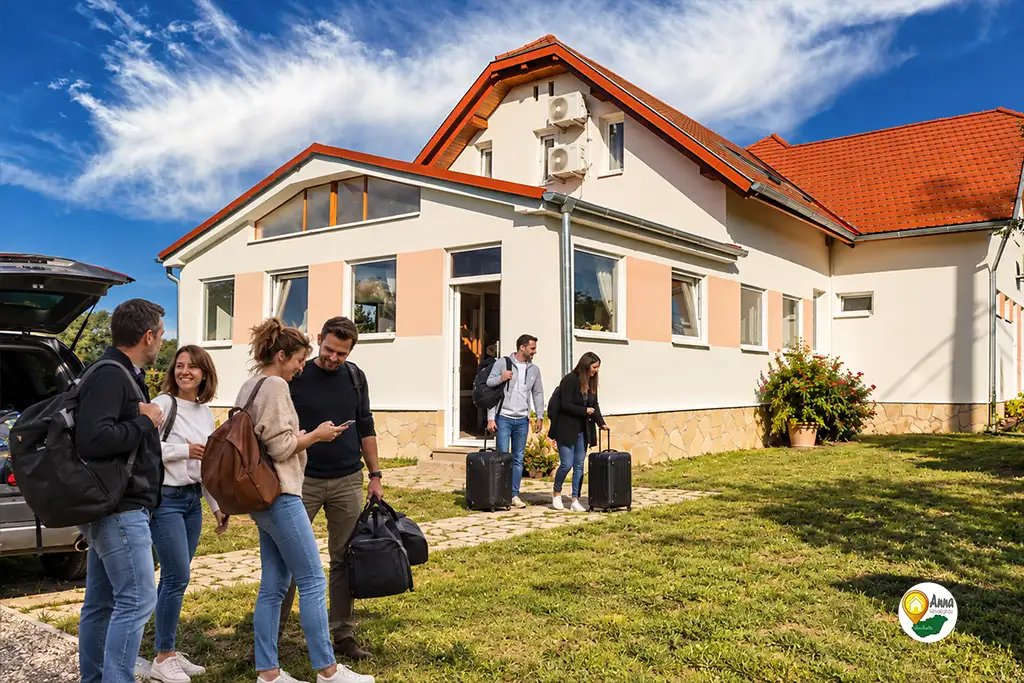

One of the team’s cars has already arrived, while the others are still unpacking at a guesthouse in the next village. The afternoon programme is over and dinner is about to start, but the group chat reveals that a few people will not make it over for another half hour. Two or three separate bookings may look flexible at first, but in practice every extra address creates another point to coordinate.
This becomes especially noticeable on a corporate team-building trip or a multi-day team gathering. It is not only about everyone sleeping comfortably; it is also about how much organising it takes to keep the team together between shared activities. The same dilemma comes up for groups of friends and several families travelling together.
There is no single right answer for every group. Sometimes staying together in one place makes the trip run more smoothly; in other situations, separate accommodation gives people the flexibility or quiet they need. The real question is how you want to spend these few days together, and how different the needs within your group are.
When does staying in one place really make things easier?
If you plan to set off together in the morning, have dinner as a group in the evening and stay around for a conversation afterwards, one shared place to stay can save you a surprising amount of small-scale coordination. You return to one address, leave from one place, and the end of the evening is not dictated by who needs to get back to which accommodation and how.
On a corporate team-building trip, this can be particularly valuable. The more formal part of the day may be over, but the team does not immediately scatter. A shared dinner or an informal evening conversation can become a natural continuation of the time spent together. For a group of friends, the same advantage is simpler: nobody has to cut a good conversation short just because it is time to travel back to another address.
Still, everyone sleeping under the same roof does not automatically guarantee a comfortable stay. After a full day of shared activities, some people may still want company while others would rather have some quiet. Good shared accommodation therefore needs to offer more than space for being together; it should also leave room for rest and different daily rhythms.
When can several separate places to stay be the better choice?
Several addresses are not automatically a compromise. They can be a very practical option if your group is larger than the capacity of one suitable property, if smaller parts of the group arrive or leave on different days, or if comfort expectations and budgets vary significantly.
The same can happen in a corporate group: one person may need more quiet or independence, while someone else is perfectly happy with a simpler room. In that situation, there is little point in forcing everyone into one arrangement simply so the group can say it is staying at the same address. The same applies to friends or families when daily routines or expectations of comfort differ considerably.
Separate accommodation can also work very well when the room is genuinely only a place to sleep. If the daytime programme, meals and meet-ups already take place elsewhere, it matters less whether everyone returns to the same property in the evening.
There is also a very practical point: if one shared house would only accommodate everyone with an awkward room plan or too many compromises, separate places may simply be the better choice. The quality of the time you spend together is not determined by whether everyone sleeps under the same roof at all costs.
Togetherness, privacy and getting around – this is where the practical difference shows
In a larger group, people rarely follow exactly the same rhythm. Someone is up early with a coffee, ready for the day’s programme, while others would rather start later. In the evening, a few people may want to keep talking while others are ready to rest. This is particularly natural on a team-building trip: spending much of the day together does not mean everyone will want the same thing in the evening.
Shared accommodation does not mean you have to do everything together twenty-four hours a day. Quite the opposite: it works well when it is easy to meet, have breakfast together or sit down in the evening, while everyone can also step away when they need to.
If you are still choosing the right place, we have covered the broader criteria separately in our guide on how to choose accommodation for a larger group. It takes you through sleeping capacity, room allocation, communal spaces and the practical way a property works for a group.
If you choose several separate places to stay, greater separation often comes with more coordination. A spontaneous evening conversation can more easily turn into a discussion about who is leaving when, and a shared morning departure means bringing the team together from several locations. That is not necessarily a problem – it is simply something worth allowing for in advance.
If your accommodation is already decided and the question is how to organise the stay itself, our guide What to consider when travelling with 8–12 people takes the topic further through arrival, communication, meals and different daily routines.
When comparing prices, compare like with like – not the number of bookings
One large total can feel very different from the price of two or three separate bookings, so it is easy to draw the wrong conclusion at first glance. You get a fair comparison only when you look at the same dates, the same number of guests and genuinely comparable services, then compare the total cost.
Separate bookings may also come with different payment and cancellation terms. These details depend on the provider and the dates, so there is no useful universal rule that says a whole guesthouse is always cheaper, or that several smaller bookings always cost more.
Price matters, but it does not always have to be the first question. It is usually more useful to establish which arrangement suits the team’s programme, shared time and need for rest, and then compare the real cost of equivalent options.
How does Anna Guesthouse fit into this?
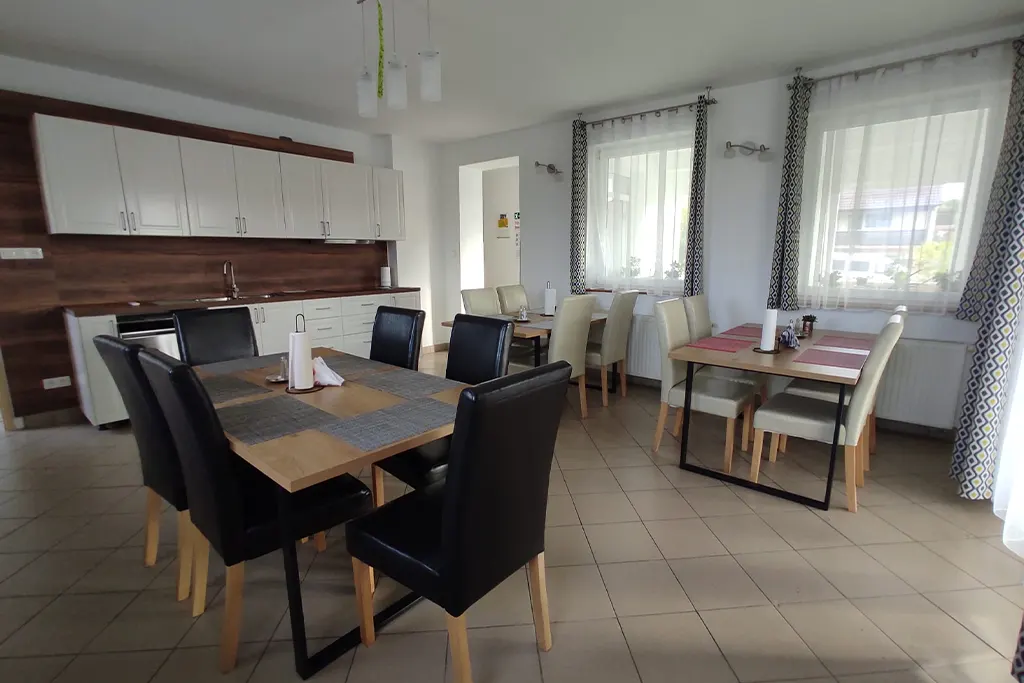
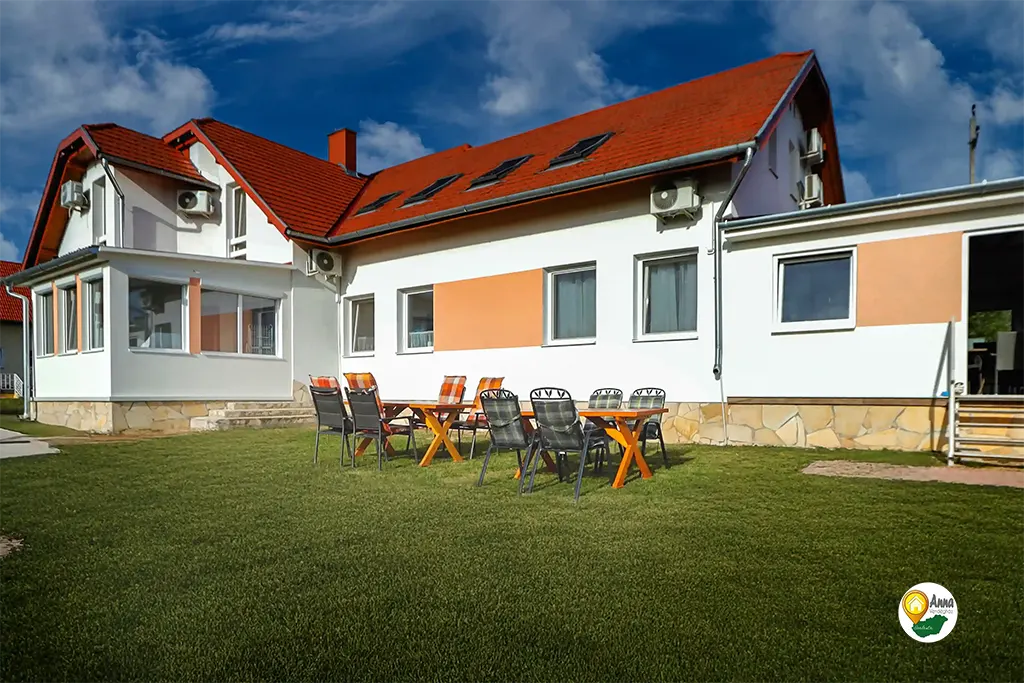
Anna Guesthouse in Szeleste, Vas County offers 6 rooms with a total capacity of 24 guests. Each room has its own bathroom, while communal spaces, an equipped kitchen and a dining area are also available. Parking can be arranged for larger groups as well.
These features are not only relevant to groups of friends or families. For a smaller corporate team-building stay, it is also worth considering whether colleagues can stay in one place, whether there is somewhere to sit down together, and whether everyone still has private room and bathroom space of their own.
It is also possible to book the whole house. With a whole-house booking, the communal areas and the garden are for your group’s use. A booking for 8–12 people does not automatically mean exclusive use of the whole house, so it is worth discussing the number of guests, the dates and any individual requirements directly with us.
You can review the layout and accommodation details on the Anna Guesthouse Visitor Info page. This makes it easier to compare, before booking, whether one shared place to stay or several separate arrangements would work better for your group.
A quick decision check before you book
If you are organising a corporate team-building trip or a multi-day team gathering and it matters that the group does not immediately split up after the shared programme, it is worth looking first for accommodation where everyone can stay in one place. The same is true for a weekend with friends when shared breakfasts, dinners and evening conversations are part of the experience itself.
If arrival times, expectations of comfort or budgets vary widely, or members of the group want more separation, several places to stay may be the more practical arrangement.
In the end, the important question is not how many booking confirmations arrive in your inbox, but how you want to spend these few days together – and how much organising you want to take on along the way.
Once your group size and dates are beginning to take shape, check the current booking options. For whole-house use, corporate groups or individual requirements, get in touch and we can discuss the details.